

Switch theme
Users and Permissions
Every employee who works at the register has their own account: a name, a PIN for logging in and a group. The group decides what the employee may do at the register and which Administration pages they see. The owner or a manager uses this page when hiring new people and when deciding who may do what.
Both screens are in the Administration side menu, under Users: Users (the employees) and User Groups (the permissions).
Availability
The Users page is seen by a group that has the Users page turned on in the Administration section, and the User Groups page by a group that has the User Groups page turned on. The Administrator group has both by default.
How users and groups work
- A user is one person. They log in at the register with their own PIN, so receipts, reports and working hours show who did what.
- A group is a set of permissions. Every user belongs to exactly one group, and you change permissions on the group, not on the user. When you change a group's permissions, the change applies to all its users from their next login.
A venue starts with three groups:
| Group | Purpose (default permissions) |
|---|---|
| Administrator | Full rights at the register and in Administration, except the My Account page. Opens Administration after login. This group cannot be deleted and always has access to Administration. |
| Shift Manager | Work at the register with shifts, the cash register, the receipts view, discounts, cancelling and clearing employees' debts. No access to Administration. |
| Staff | Selling at the register; in hospitality also discounts and cancelling rounds. No shifts, cash register, receipts view or Administration. |
You see the exact list of a group's permissions when you open it. You can rename and change the groups and add new ones (for example "Waiter" or "Bartender").
Note
Your owner account, with the administrator PIN from the first setup, is not shown in the lists. It belongs to a special group, Manager, which has all rights and cannot be changed. You change your own PIN in My Account, on the Account tab, in the Security section (the CHANGE PIN button).
Adding an employee
In the side menu, choose Users → Users. The list shows the username, full name, group and status of each employee. In the search field, type an employee's username or name.
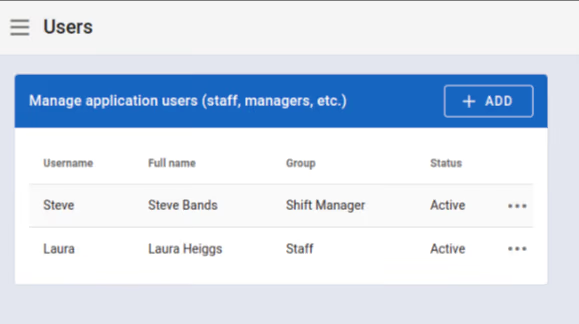
The list of employees
To add a new employee:
- On the Users page, click ADD. The Add user window opens.
- Fill in the fields (see the table below).
- Click SAVE.
The employee appears in the list and can log in at the register with their PIN right away.
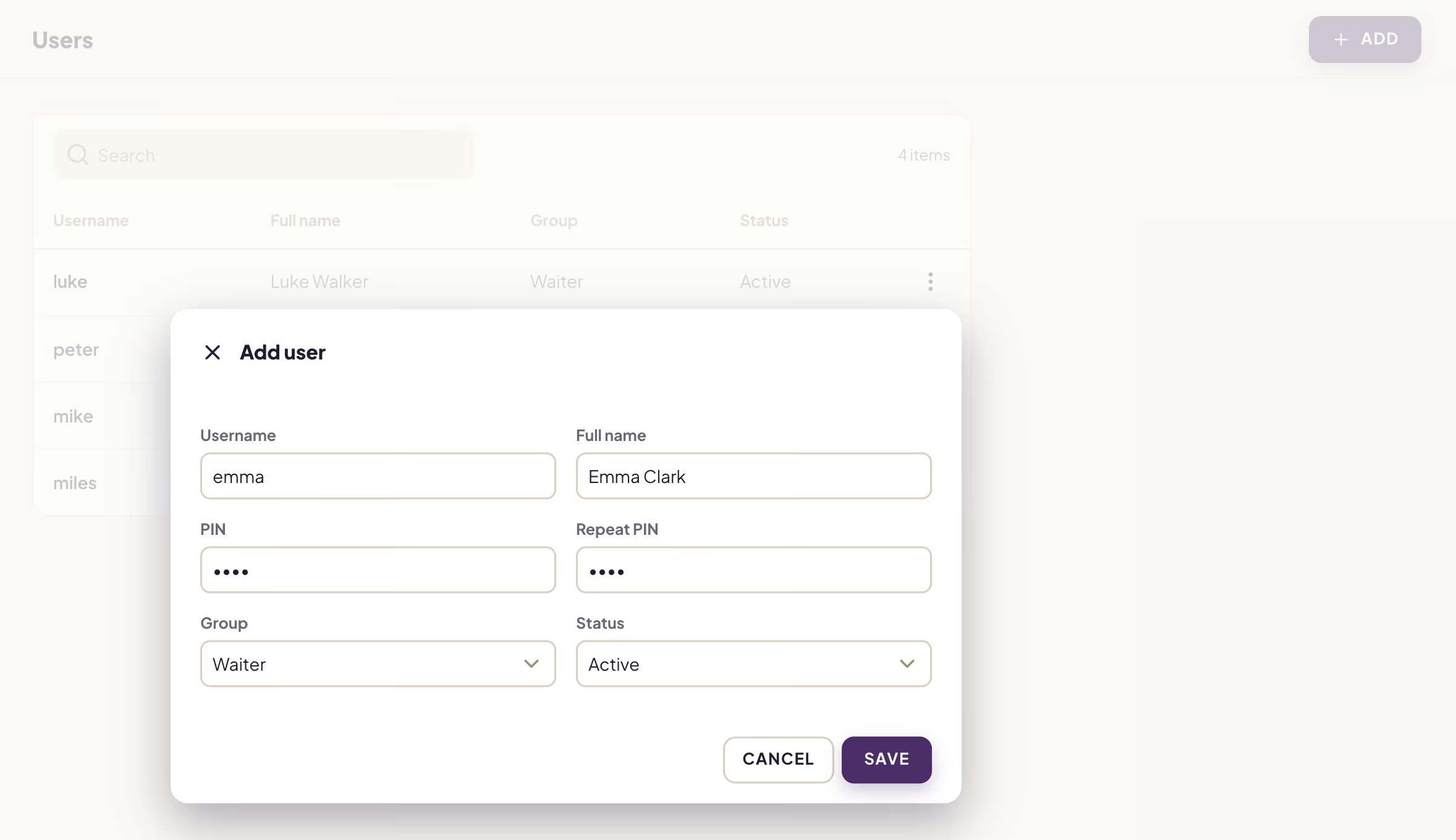
A new employee: PIN, group and status
| Field | What you enter |
|---|---|
| Username | A short name for recognizing the employee in Administration (for example "emma"). It must be unique. |
| Full name | The employee's full name. It is printed on the receipt as the Operator. |
| PIN and Repeat PIN | The number the employee logs in with at the register and in Administration. Both fields must match. |
| Group | Decides what the employee may do (see What each permission allows). |
| Status | Active — the employee can log in. Inactive — the account stays with all its history, but the employee cannot log in. |
Warning
The PIN must be unique in the whole venue, because it identifies who is logging in. If the PIN is already taken, the window is not saved, and "Invalid pin." is shown below the PIN field — choose another one.
Tip
Use digits only for the PIN: at the register it is typed on a numeric keypad.
Editing a user and changing the PIN
Click the employee in the list (or ⋮ → Edit). The Edit user window opens with their details.
- To change the PIN, enter the new PIN in the PIN and Repeat PIN fields.
- If you leave the PIN fields empty, the employee keeps the old PIN.
Click SAVE.
Do not delete an employee who is temporarily not working (a seasonal worker, sick leave) — set their Status to Inactive. When they come back, set the status back to Active; the PIN and the history stay the same.
Deleting a user
- In the employee's row, choose ⋮ → Delete.
- Confirm the deletion ("Permanently delete User?") by clicking CONFIRM.
The deleted employee is no longer shown in the list and cannot log in. The receipts they issued remain. Their username and PIN can be given to someone else.
An employee who has a debt in the current shift cannot be deleted ("User has unpaid debt and cannot be deleted."). Clear their debt at the register first (see Working Day → Clearing employee debt).
Creating a group
You create a group when none of the existing ones fits an employee's job — for example a waiter who may cancel rounds, but not single items.
New group
- In the side menu, choose Users → User Groups.
- Click ADD. The new group's page opens.
- In the Name field, enter the name of the group. The name must be unique.
- Scroll through the Navigation, Administration and Activity permissions sections, one below the other, and turn off with the switches everything the group may not do.
- Click SAVE in the page header.
The group appears in the list and you can assign it to employees.
Warning
A new group starts with all the permissions of the Administrator group, including access to Administration. If you only enter a name and save, the employees in that group get almost full rights. Before saving, carefully turn off everything the group does not need.
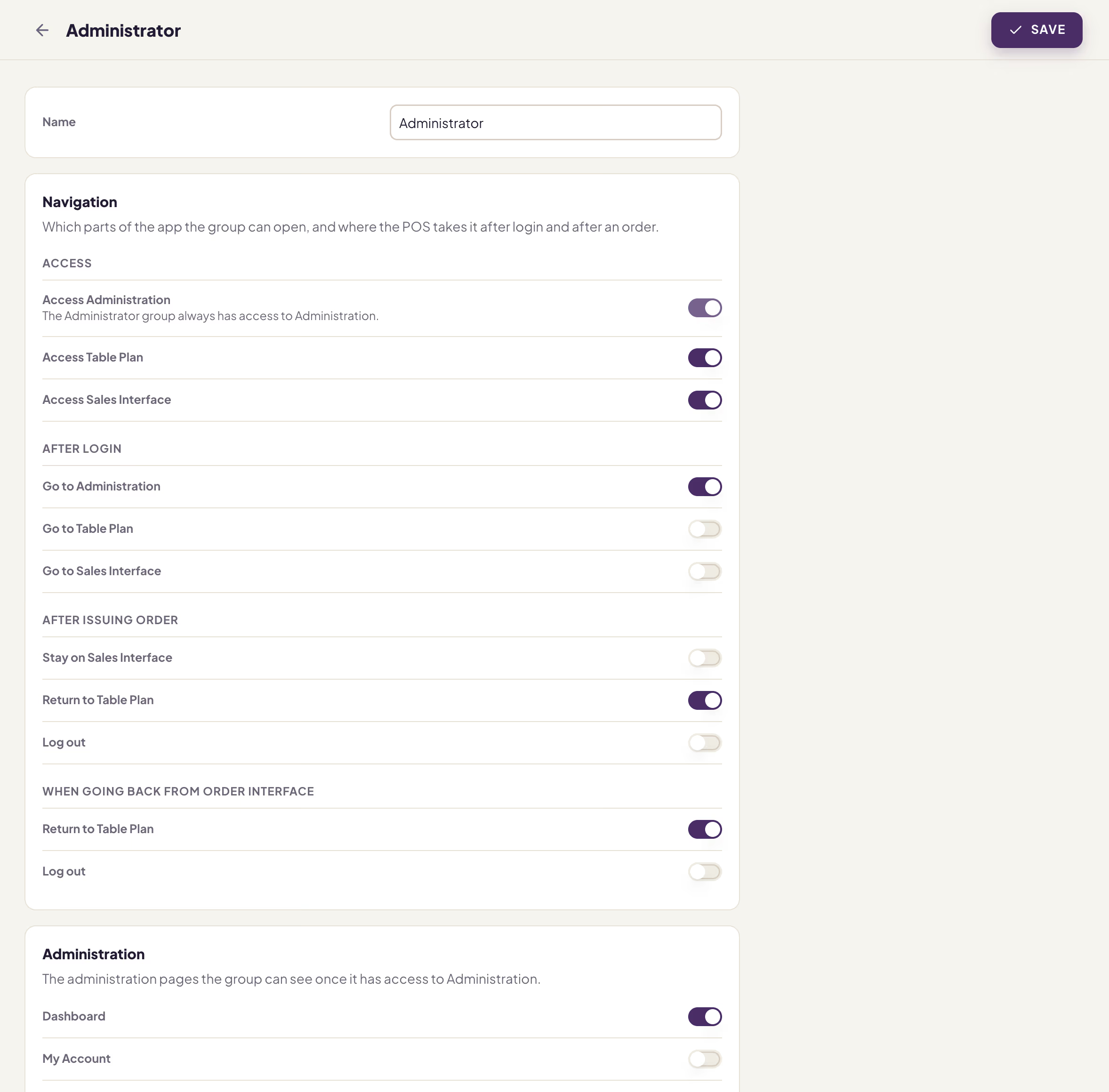
Editing a group: sections with switches
Copy of an existing group
A faster and safer start is a copy of the group closest to what you need:
- On the User Groups list, in that group's row, choose ⋮ → Copy.
- A new group opens with the same permissions and a name with "copy" added (for example "Waiter copy"). Change the name and the permissions.
- Click SAVE.
What each permission allows
On the group page, the permissions are divided into three sections, one below the other: Navigation, Administration and Activity permissions. Each permission is one switch. Within a section, the permissions are grouped under headings, in the same order as on the screen.
Hospitality venues and retail venues do not see the same permissions: the permissions for tables, rounds and discounts exist only in hospitality, and the Sell items screen and keyboard shortcuts only in retail. The Business type column shows where a permission is shown.
Navigation
Which parts of the app the group can open, and where the register takes it after login and after an order.
| Heading | Permission | What it allows | Business type |
|---|---|---|---|
| Access | Access Administration | Entering Administration — from the register (Options → Administration) and from a browser. When it is off, all the permissions in the Administration section are turned off too. | both |
| Access Table Plan | The table plan at the register. | hospitality | |
| Access Sales Interface | In hospitality, the order screen: entering, sending and charging orders. In retail, the Sell items screen. | both | |
| After login | Go to Administration | Administration opens after the PIN login. Requires Access Administration. | both |
| Go to Table Plan | The table plan opens after login. | hospitality | |
| Go to Sales Interface | In hospitality, the order screen opens after login; in retail, the Sell items screen. | both | |
| After issuing order | Stay on Sales Interface | After sending an order or charging, the waiter stays on the order screen of the same table. | hospitality |
| Return to Table Plan | After sending an order or charging, the register returns to the table plan. Also requires Access Table Plan. | hospitality | |
| Log out | After sending an order or charging, the register returns to the PIN screen. | hospitality | |
| When going back from Order interface | Return to Table Plan | The back arrow on the order screen leads to the table plan. Also requires Access Table Plan. | hospitality |
| Log out | The back arrow on the order screen logs the waiter out (PIN screen). | hospitality |
Rules of the section:
- At least one permission under Access must stay on.
- Under After login, After issuing order and When going back from Order interface, exactly one permission is on — when you turn on another one, the previous one is turned off.
- A permission that depends on an access that is turned off is grey and cannot be turned on.
- A group without access to the sales screens goes straight to Administration after login.
Administration
Each switch in this section is one Administration page, with the same name as in the side menu. The group sees only the pages whose switch is on. The section is available only when Access Administration is on.
| Heading | Permission | What it opens | Business type |
|---|---|---|---|
| — | Dashboard | The start page of Administration. Leave it on for a group with access to Administration — without it the employee cannot enter Administration (see Who sees which pages). | both |
| My Account | The Company, Receipts, Integrations and Settings pages under My Account. The Account page is seen only by the account owner. | both | |
| Users | Users | The list of employees: adding, PINs, deleting. | both |
| User Groups | Groups and their permissions. | both | |
| Stock | Inventory Items | The list of items. Adding and editing also require the Allow adding inventory items and Allow updating inventory items permissions. | both |
| Item Categories | Item categories. | both | |
| Item Modifiers | Item modifiers. | hospitality | |
| Pricelists | Pricelists (with the Pricelists module, when the venue does not keep inventory accounting). | hospitality | |
| Clients | Clients | The list of buyers and suppliers. | both |
| Client Transactions | Client transactions. The switch is shown when the venue keeps inventory accounting. | both | |
| Bank Statements | Bank statements. The page exists when the venue keeps inventory accounting. | both | |
| Inventory Accounting | Delivery-in Notes | Delivery-in notes. | both |
| Delivery-out Notes | Delivery-out notes. | both | |
| Beginning Inventories | Beginning inventories. | both | |
| Price Calculations | Price calculations. | both | |
| Price Levelings | Price levelings. | both | |
| Write-Off | Write-offs. | both | |
| Daily Cash Sales | Daily cash sales. | both | |
| Stock | The stock list and the transactions of each item. | both | |
| Sales Purchase Ledger | The sales purchase ledger. | both | |
| Reports | Receipts & Orders | Issued receipts and incoming invoices. | both |
| Sales Reports | Sales reports. | both | |
| Working Hours | Employees' working hours. | both | |
| Settings | Tax Rates | Tax rates. | both |
| Printers | Has no page of its own in Administration. Printers at the register are set up by an employee with the Allow printers setup permission. | both | |
| Weight Barcodes | Weight barcodes (with the Scales integration). | both | |
| Keyboard Shortcuts | Keyboard shortcuts. | retail | |
| Table Plan Settings | The table plan in Administration and editing the table plan directly at the register. | hospitality | |
| Sales Interface Settings | The button layout in Administration and editing the buttons directly at the register. | hospitality | |
| Terminals | The list of devices (see Settings → Terminals) and the full kitchen view from the register (without this permission, only completed orders are shown). | hospitality |
The permissions under Inventory Accounting, except Delivery-in Notes and Delivery-out Notes, are shown only when the venue keeps inventory accounting. In retail with inventory accounting there are no Delivery-in Notes and Delivery-out Notes pages. The Delivery Platforms page is seen by everyone with access to Administration when the delivery module is on. The Beach Settings page has no switch in the group: with the beach module, the account owner and the Administrator group see it by default.
Warning
Whoever has the User Groups page can change permissions — including those of their own group. Give the Users and User Groups pages only to people you trust.
Activity permissions
What the group may do at the register.
| Permission | What it allows | Business type |
|---|---|---|
| Allow opening/closing shifts | Opening and closing the shift on a device registered as a cash register (see Working Day). | both |
| Allow cash register management | The Cash Register window (cash, deposit and cash withdrawal), the Reports item in the main menu and registering a device as a cash register. | both |
| Allow user management | On the Working Day screen, the employee sees the sales of all employees; without it, only their own. | both |
| Allow fast order | The FAST ORDER button on the table plan (see Hospitality Sales). | hospitality |
| Allow access to all tables | Opening other waiters' tables, transferring to another waiter's table without their PIN, and approving QR orders for other waiters' tables without an extra confirmation. | hospitality |
| Allow order discount | A discount on the whole receipt. In retail this discount is always allowed. | hospitality |
| Allow order item discount | A discount on a single item. In retail this discount is always allowed. | hospitality |
| Allow order canceling | Cancelling a new round, deleting a sent round and Cancel all on a table (see Cancelling orders). | hospitality |
| Allow order item canceling | Deleting a single item from a sent round; a cancellation slip is printed. | hospitality |
| Allow receipts view | The Receipts screen at the register: viewing, cancelling, copies and other actions with issued receipts (see Receipts). | both |
| Allow clearing of own debt | The employee clears their own debt on the Working Day screen. | both |
| Allow clearing debt of all employees | Clearing the debt of every employee on the Working Day screen (see Clearing employee debt). | both |
| Allow printers setup | The Printers card in the register's Options (see Printers). | both |
| Allow adding inventory items | Adding and copying items — at the register (Options → Products) and in Administration. | both |
| Allow updating inventory items | Editing and deleting items and quick price changes (Prices) — at the register and in Administration. | both |
Editing and deleting a group
Editing a group
- In the User Groups list, click the group (or ⋮ → Edit). The group's page opens with its name as the title.
- Change the name or the switches.
- Click SAVE. You return to the list of groups.
The change applies to all employees in the group from their next login. If you leave the page without saving, the app asks whether you want to discard the changes.
The Administrator group always keeps Access Administration — this switch is locked, so that nobody locks Administration by mistake. You can change the other permissions of the Administrator group.
Deleting a group
- In the group's row, choose ⋮ → Delete.
- Confirm the deletion ("Permanently delete user group?") by clicking CONFIRM.
The Administrator group has no Delete option. A group that has employees cannot be deleted ("User group could not be deleted because it has a user fulfilling it.") — first move those employees to another group (see Editing a user). If a deleted employee also belonged to the group, the group cannot be deleted — rename it or turn off its permissions.