

Switch theme
Settings
In the Settings group of Administration you set up what applies to the whole venue: tax rates, the layout of tables and buttons at the register, shortcuts, devices and connected platforms. Which pages you see depends on the type of venue, the modules turned on and your user group's permissions:
| Page | What it is for | Availability |
|---|---|---|
| Tax Rates | The tax rates your items and receipts use. | All venues |
| Terminals | Registered devices: cash registers, waiters' devices, kitchen display. | Hospitality |
| Table Plan Settings | Sectors and the layout of tables. | Hospitality |
| Sales Interface Settings | Category and item buttons at the register. | Hospitality |
| Keyboard Shortcuts | Keyboard keys for the most common actions at the register. | Retail |
| Weight Barcodes | How the register reads the labels printed by a scale. | Scales integration |
| Delivery Platforms | Connecting with delivery platforms, receiving orders and the menu. | Delivery module |
| Beach Settings | Season, opening hours, zones and the sunbed booking portal. | Beach module or online beach booking module |
A page is seen by an employee whose group has access to it — in the user group, in the Administration section, the pages are listed with the same names as in the menu (see Users and Permissions).
Note
Most of these pages save every change immediately. Weight Barcodes and Beach Settings have a SAVE button in the page header; if you leave the page before saving, the app asks "Leave this page?".
Tax Rates
On the Tax Rates page you keep your venue's tax rates. Every item gets one of them in its Tax rate field, and the receipt shows the tax per rate. A new account has no tax rates — add yours before you add or import items (see Inventory).
| Column | What it shows |
|---|---|
| Label | The name of the rate, for example "VAT". The label is shown in the item window and in the tax summary on the receipt. |
| Applies to | Items — the rate applies to the items it is assigned to. Whole Order — the rate applies to the total of every receipt. |
| Rate | The rate in percent. |
Adding a tax rate
- Click ADD. The Add Tax Rate window opens.
- Enter the Label and the Rate in percent (up to 99, with up to two decimals).
- Under Applies to, choose Items or Whole Order.
- Click SAVE.
The rate appears in the list with the message "Tax Rate saved successfully".
- A rate that applies to Items works only on the items it is assigned to: choose it in the Tax rate field of each item (see Item fields), or enter its percentage in the tax rate column when you import items (see Importing items from Excel).
- A rate that applies to the Whole Order is active as soon as you save it: it is calculated on the total of every following receipt, without being assigned to items.
Editing and deleting a tax rate
Click the rate's row (or ⋮ → Edit), change the label, the rate or what it applies to, and click SAVE. To delete a rate, choose ⋮ → Delete and confirm "Permanently delete Tax Rate?" with CONFIRM.
Warning
A changed rate applies to the receipts issued after the change; receipts already issued keep the tax they were issued with. A rate that is assigned to items or was used on issued receipts cannot be deleted — it stays in the list. Delete only a rate you added by mistake and never used.
Availability
All venues. The page is seen by an employee whose group has access to the Tax Rates page. If the list shows no ADD button and the rows do not open, tax rates are not editable for your venue — contact Konty support.
Terminals
The Terminals page lists all devices registered at your venue. Here you change a device's name and delete devices that are no longer used. You do not add devices here: a device appears in the list when you register it on the device itself (see Devices).
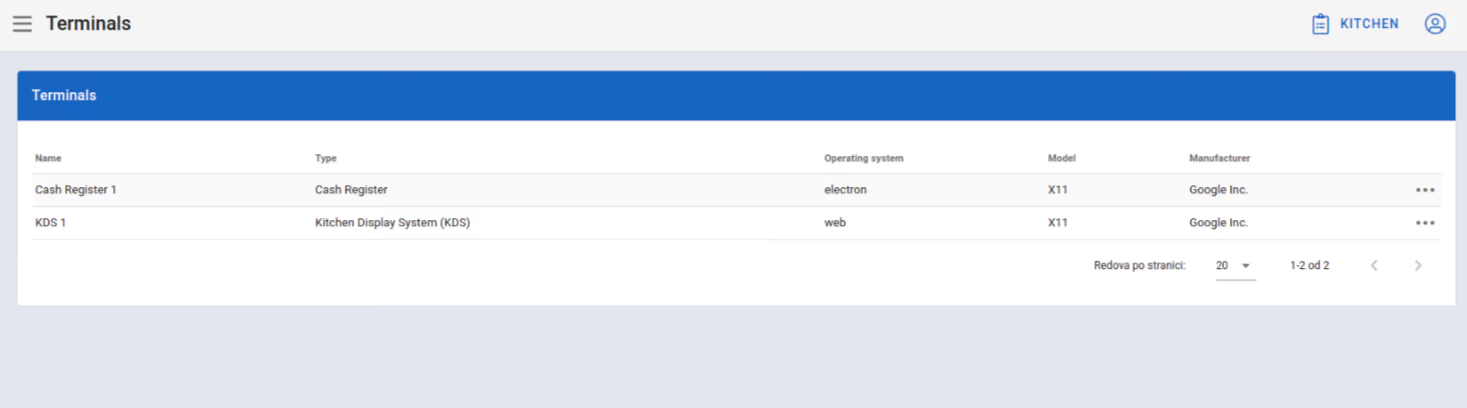
Each registered device with its type, operating system, model and manufacturer
| Column | What it shows |
|---|---|
| Name | The device's name. For a remote ordering device, the name also shows the cash register it works through (for example "Mark / Register 1"). |
| Type | Cash Register, Remote Ordering Device or Kitchen Display System (KDS) (see Devices). |
| Operating system, Model, Manufacturer | The details the device reported when it was registered. |
You find a device by searching for its name above the list.
Availability
Hospitality venues. The page is seen by an employee whose group has access to the Terminals page.
Renaming a device
- Click the device's row (or ⋮ → Edit).
- In the Terminal window, change the Name.
- Click SAVE.
The name must be unique among the venue's devices. You cannot change the Type or the cash register of a remote ordering device. The name of a cash register is also the name you see on the Working Day screen and in reports.
Deleting a device
- Click ⋮ at the end of the device's row and choose Delete.
- Confirm the deletion with the CONFIRM button.
A deleted device is no longer registered. To use it again, register it anew (see Devices).
Warning
You cannot delete a cash register — the Delete option is disabled for it. You move a cash register to another device with the help of support.
Table Plan Settings
On the Table Plan Settings page you create sectors (for example Dining room, Patio, Garden) and arrange the tables the way waiters see them at the register. Every change is saved immediately — the page has no save button.
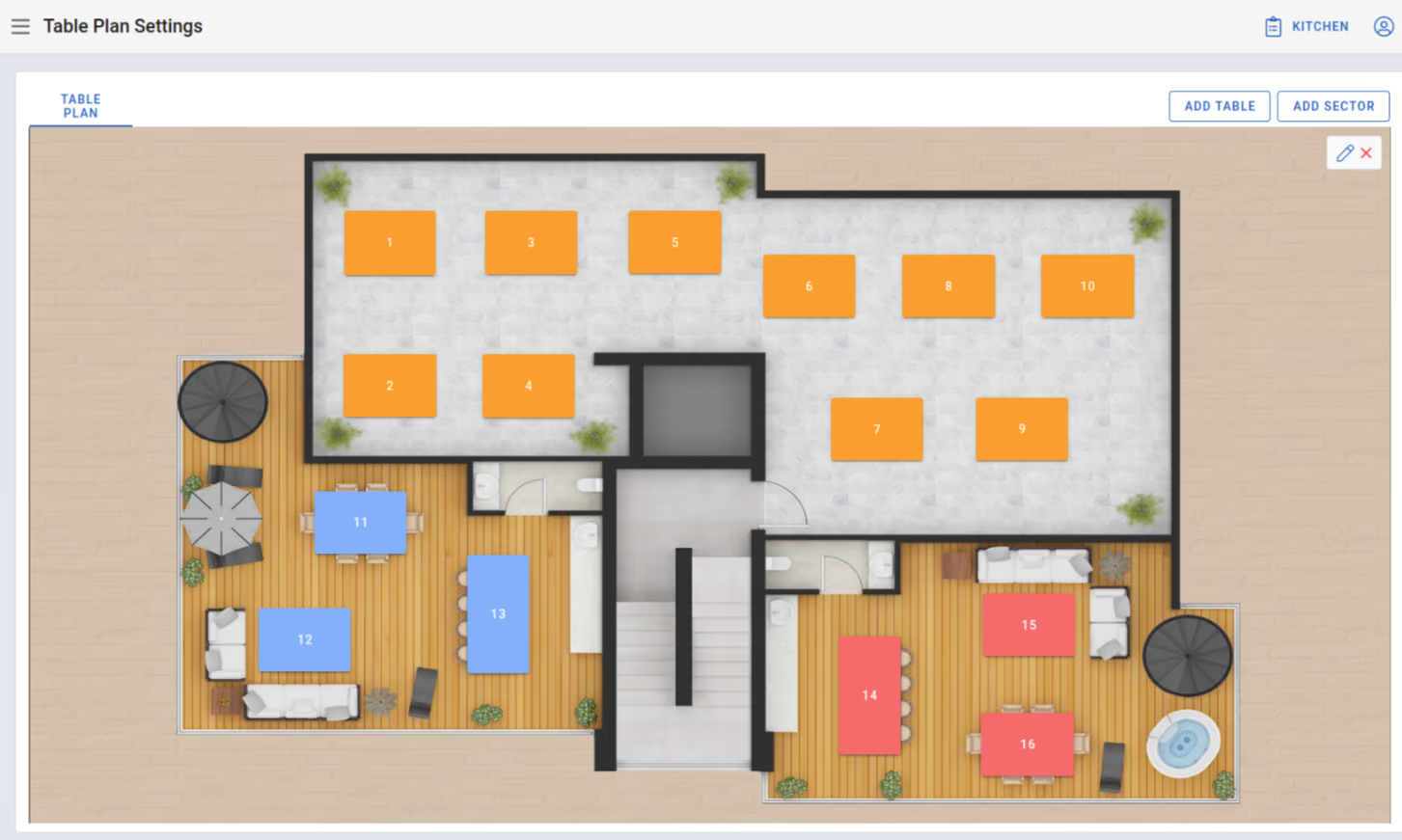
Sector tabs above the plan; the active sector carries a pencil for editing
Above the plan are the sector tabs, and in the page header the ADD SECTOR and ADD TABLE buttons and the ⋮ menu. You can also change the same layout directly at the register (see Hospitality Sales).
Availability
Hospitality venues. The page is seen by an employee whose group has access to the Table Plan Settings page.
Adding a sector
- Click ADD SECTOR.
- In the Add sector window, enter the Sector name.
- Under Select image, choose the sector's background: No image, Upload image (an image up to 5 MB) or one of the images uploaded earlier.
- Click SAVE.
The new sector opens as the active tab, ready for adding tables.
Adding and arranging tables
Click ADD TABLE. The table is placed on the first free spot near the middle of the plan and gets the first free number in the sector. You move a table by dragging it, and change its size by dragging its edges.
Clicking a table selects it — a toolbar appears at the bottom of the screen:
| Tool | What it does |
|---|---|
| Color palette | Changes the table's color. |
| Trash can | Deletes the table, without an extra confirmation. |
| Name field | The table name waiters see on the plan (up to 30 characters). |
| Rectangle, Round | The table's shape. |
| Duplicate | Creates the same table on a free spot. |
| Print (QR code) | Prints the QR code of that table; shown when QR ordering is on. |
Clicking an empty part of the plan closes the toolbar.
Warning
You cannot delete a table that has unpaid orders — the app reports "There are unpaid orders on this table".
Editing several tables at once
You select several tables by drawing a frame around part of the plan with the mouse (dragging over an empty part of the plan) or by clicking tables while holding the Shift, Ctrl or Cmd key. The bar at the bottom then changes all selected tables at once: color, shape and deletion (with the confirmation "Delete … tables? This cannot be undone."), and it also has alignment tools:
| Tool | What it does |
|---|---|
| Left edges | Aligns the tables by their left edge. |
| Top edges | Aligns the tables by their top edge. |
| Spread across | Makes equal gaps between the tables horizontally. |
| Spread down | Makes equal gaps between the tables vertically. |
You can also drag the selected tables together to another spot.
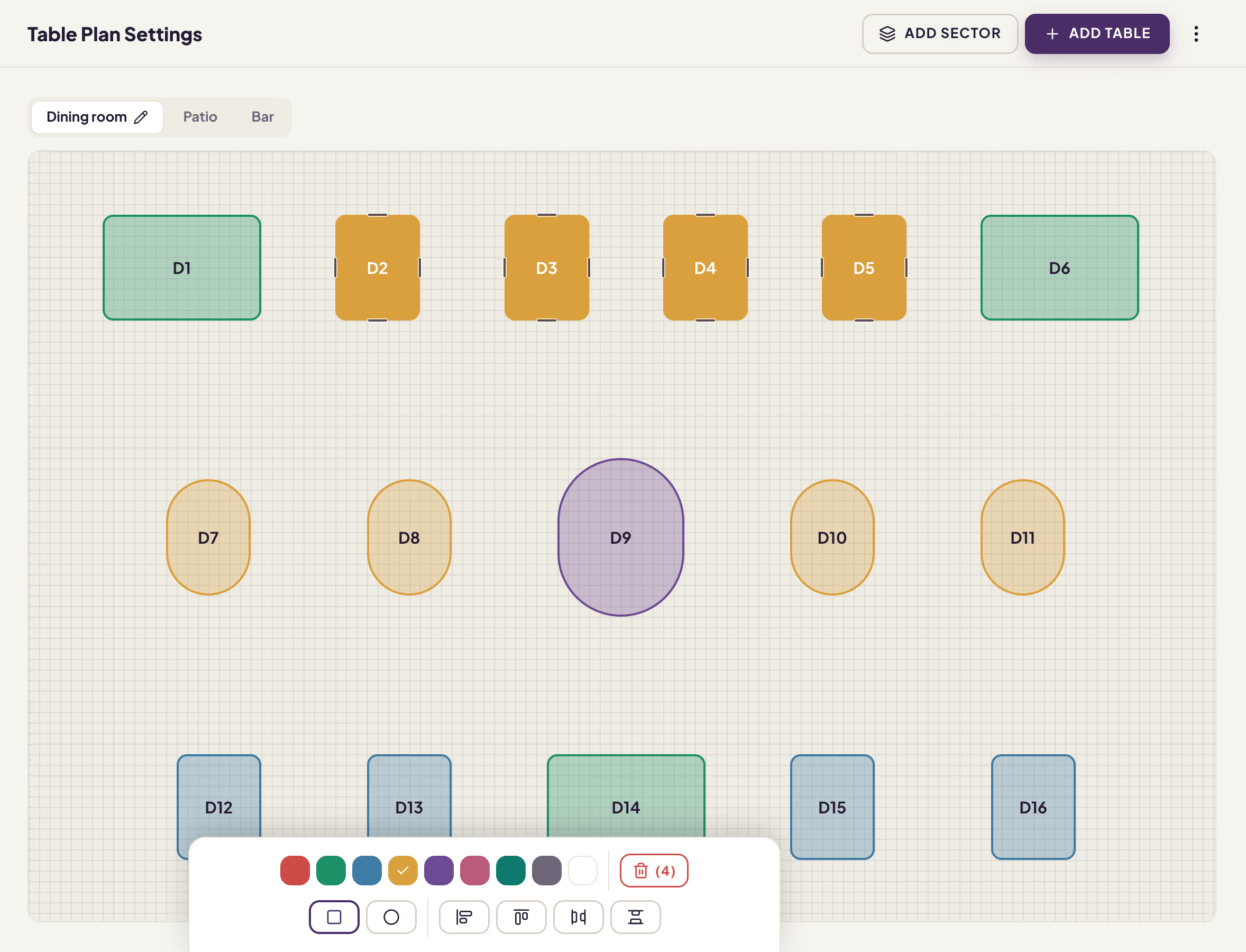
Several selected tables: the bar gets the alignment and spacing tools
Editing and deleting a sector
Click the pencil on the active sector's tab (or click the active tab again):

The pencil on the active sector's tab opens the sector for editing
In the Edit sector window, change the name or the image and click SAVE. To delete the sector, click DELETE in the same window and confirm "Permanently delete sector?" with the CONFIRM button.
Warning
Deleting a sector also deletes all its tables. You cannot delete a sector that has unpaid orders.
Printing QR codes for tables
When QR ordering is on, you print the QR codes for all tables of the active sector from the ⋮ menu in the header → Print QR Codes. You print the QR code of a single table from that table's toolbar (see the table above). How guests order with the QR code is described on the page Orders: QR Ordering and Delivery.
Availability
Print QR Codes is active when QR ordering is turned on in My Account → Settings (see QR ordering settings).
Sales Interface Settings
On the Sales Interface Settings page you arrange the category and item buttons the waiter uses on the order screen. Every change is saved immediately.
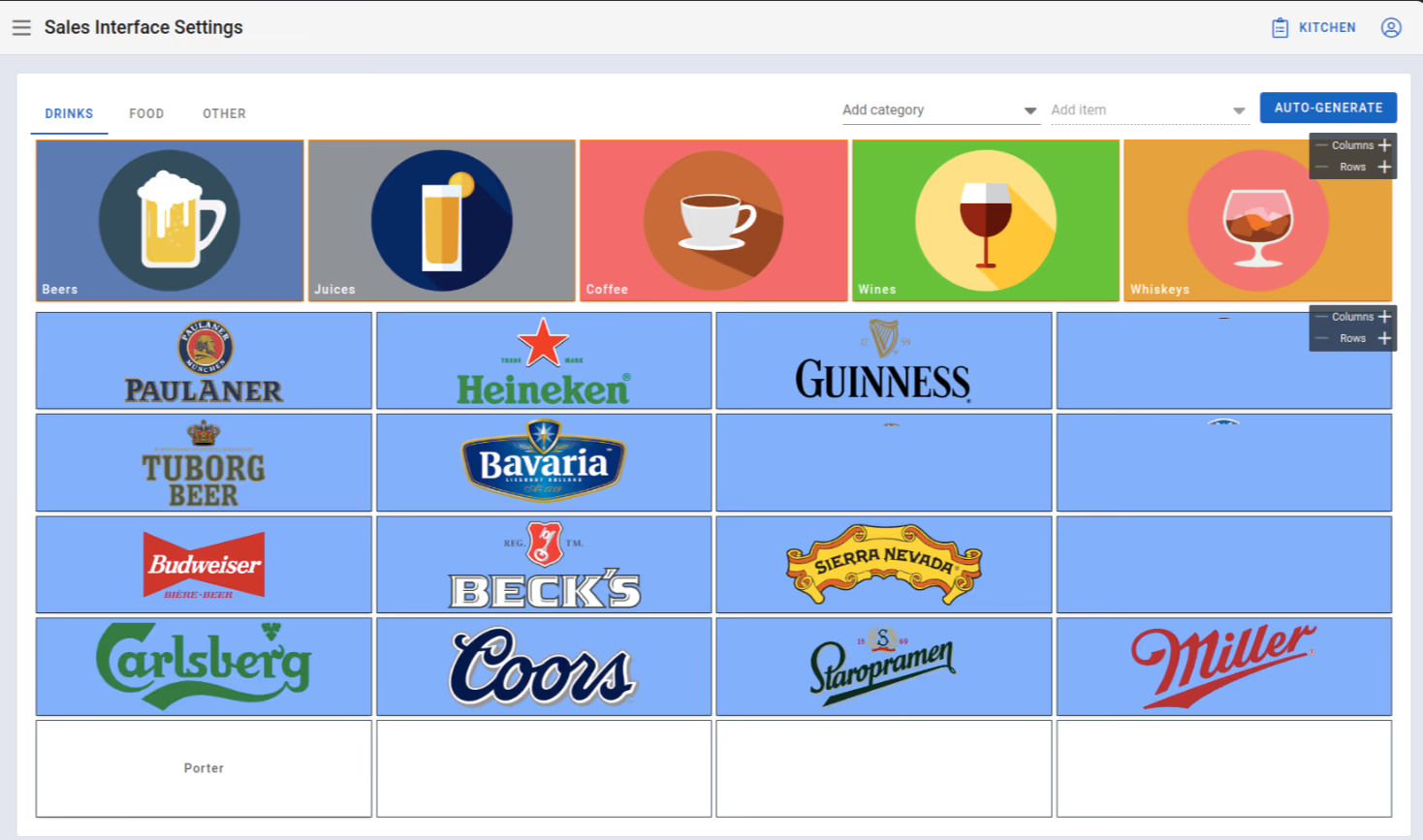
Category buttons at the top, the selected category's items below; each part has its own Columns and Rows
The page has the Drinks, Food and Other tabs. A category is shown on the tab that matches its Type field (see Item categories). Each tab has two parts: Categories and the Items of the selected category. Clicking a category button chooses whose items are shown.
Availability
Hospitality venues. The page is seen by an employee whose group has access to the Sales Interface Settings page. You can also change the buttons directly at the register (see Hospitality Sales). In retail, you set up the quick buttons at the register (see Retail Sales).
Adding a button
- Click an empty field with the + sign — in the Categories part for a category button, and in the Items part for an item button of the selected category.
- In the Settings window, in the Add category or Add item field, choose the entry. The list contains only categories and items that do not have a button yet.
- Shorten the Button name if needed.
- Choose the Button color. An item button gets its category's color in advance.
- Optionally, upload an image for the button under Image (advanced).
- Click SAVE.
The button is placed on the field you clicked.
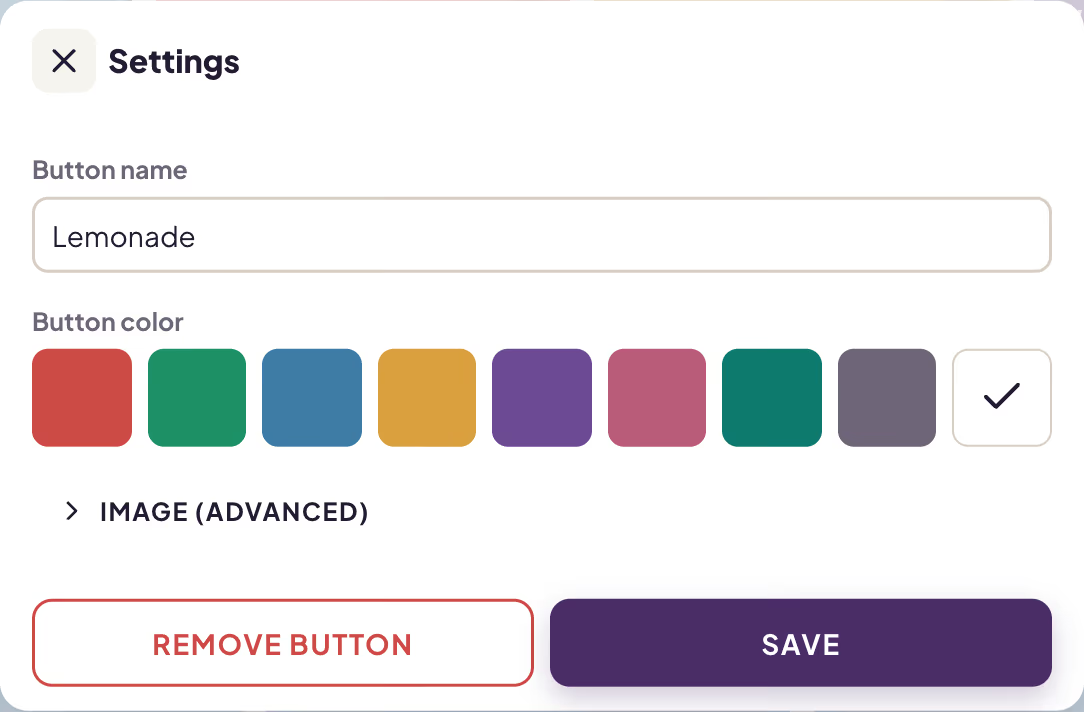
Editing a button: name, color and image; REMOVE BUTTON takes it off the screen
Editing, moving and removing buttons
Every button has a pencil icon that opens the Settings window for that button:
- Editing: change the Button name, Button color or image and click SAVE. When you change the color of a category button, the colors of its items change too — but only if all the items of that category still have the same color as the category.
- Moving: drag the button to another field.
- Removing: in the button's window, click REMOVE BUTTON. The button is removed from the register; the item and the category stay in Inventory.
Older buttons with an image switch to the new look the first time you edit them, and the image stays ("Saving switches this button to the new look — the image stays.").
Warning
Removing a category button also removes all the buttons of its items. Before that, the app asks for confirmation and says how many item buttons are removed.
Grid size
You change the number of fields with the − and + buttons next to Columns and Rows — separately for the Categories part and for the Items part. If shrinking the grid leaves some buttons outside it, the app asks whether to hide them. Hidden buttons stay saved and come back when you enlarge the grid again.
Creating buttons automatically
The AUTO-GENERATE button in the header creates buttons from your categories and items. The app asks: "Missing buttons will be automatically generated. Do you want to delete existing buttons and re-create all from scratch?"
| Answer | What happens |
|---|---|
| YES | All existing buttons are deleted and the whole layout is created from scratch. |
| NO | The existing buttons stay; only the missing buttons are added. |
| CANCEL | Nothing changes. |
Warning
YES deletes the layout you arranged by hand — the colors, names and positions of the buttons. If you only added new items or categories, choose NO.
Keyboard Shortcuts
On the Keyboard Shortcuts page you assign keyboard keys to the most common actions at the register, so the cashier works faster, without a mouse. How the shortcuts are used at the register is described on the page Retail Sales.
Availability
Retail venues; the shortcuts work at a register on a computer with a keyboard. The page is seen by an employee whose group has access to the Keyboard Shortcuts page.
To assign a key:
- Click the field next to the action (for example Pay by cash).
- When the Press the desired keyboard key window opens, press the key on the keyboard.
The shortcut is saved immediately, with the message "Saved successfully.". The allowed keys are F1–F12, Esc, Cmd, Option, Ctrl, Alt, Shift, Insert, Delete, Home, End, PgUp and PgDown; for other keys the app reports "Key not allowed". If the same key was already assigned to another action, that action is left without a shortcut. You remove a shortcut by clicking the × in the field.
| Action | What the shortcut does at the register |
|---|---|
| Update item count, Update item price, Give discount to an item | Opens the change of quantity, price or discount of the selected item. |
| Delete item | Deletes the selected item. |
| Delete last item | Deletes the last item on the receipt. |
| Pay by cash | Payment in cash, like the CASH button. |
| Pay by credit card | Payment by card, like the CARD button. |
| Pay by invoice | Opens the Receipt details window (see Issuing Receipts). |
| Assign customer | Opens the choice of buyer. |
| Cancel order | Discards the receipt that has not been issued yet. |
| Issue proforma invoice | Currently has no effect at the register — you issue a proforma invoice in the Receipt window, which the DETAILS button opens (see Proforma invoice). |
The shortcuts work while the shift is open and the receipt has at least one item. Actions with an item apply to the item you clicked, and if you have not selected one — to the last item on the receipt.
Weight Barcodes
A scale prints a label with a barcode that contains the item's code and the weighed quantity. On the Weight Barcodes page you describe the layout of the digits in that barcode, so that the register adds the right item with the right quantity when it is scanned.
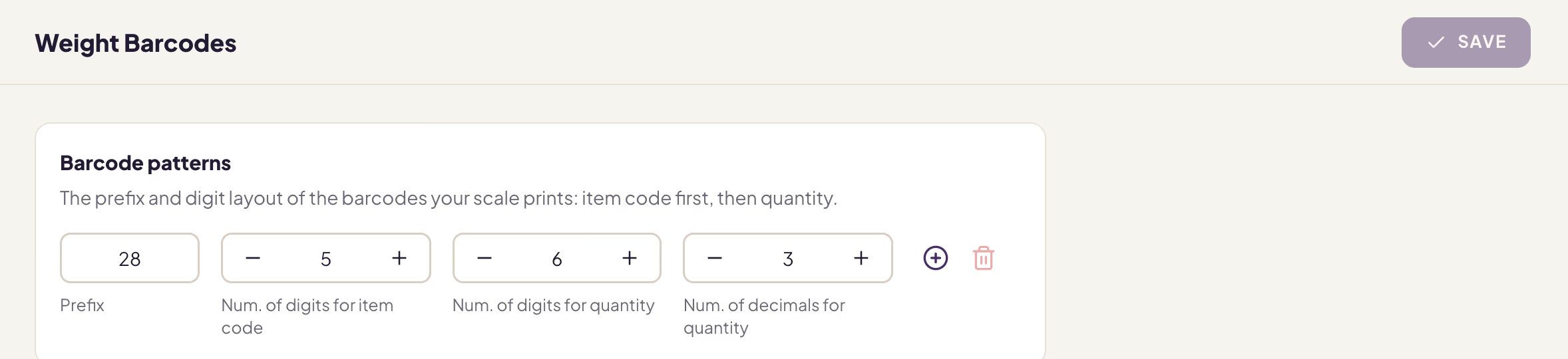
One row is one barcode pattern; you copy the values from the scale's settings
Each row is one pattern:
| Field | What it means |
|---|---|
| Prefix | The digits a barcode from the scale starts with (for example 28). Each pattern must have a different prefix. |
| Num. of digits for item code | How many digits after the prefix make up the item code (at least 4). |
| Num. of digits for quantity | How many digits after the code make up the quantity (at least 4). |
| Num. of decimals for quantity | How many of the last digits of the quantity are decimals; it must be less than the number of digits for the quantity. |
An example with the pattern 28 / 5 / 6 / 3: the barcode 2800123001250 is the item with the code 123 (00123) and the quantity 1.250 (001250 with three decimals). The code is compared with the item's Code field, and leading zeros are not counted.
To set up the patterns:
- If there is no pattern, click ADD; you add the next pattern with the + icon at the end of the last row.
- Enter the Prefix, and with the − and + buttons set the number of digits for the code, the number of digits for the quantity and the number of decimals, according to the scale's settings.
- Click SAVE in the page header.
You remove the last pattern with the trash can icon at the end of the row (the first pattern cannot be removed).
Availability
The page exists when your plan includes the Scales integration (see My Account — Integrations). It is seen by an employee whose group has access to the Weight Barcodes page.
Delivery Platforms
On the Delivery Platforms page you connect the venue with delivery platforms (Wolt, Glovo), choose the register that receives their orders, link the platform's items with your own items and send your menu to the platform. How orders from a platform are processed at the register is described on the page Orders: QR Ordering and Delivery.
Availability
The page exists when the delivery module is turned on. It has no permission of its own — everyone with access to Administration sees it. You can connect Wolt yourself (the CONNECT WOLT button); Glovo is connected by Konty support. While no platform is connected, the page reports "No delivery platforms configured. Contact support to set up a delivery integration."
Order intake
The Order intake section has two settings that are saved as soon as you change them:
| Setting | What it does |
|---|---|
| Designated Delivery Terminal | The cash register that processes the platform's orders automatically. Any cash register (auto) leaves the processing to any cash register of the venue. |
| Require staff confirmation before sending delivery orders to kitchen | When it is on, an order from the platform does not go to the bar and kitchen by itself — it waits on the Needs Action tab until the staff send it with the SEND TO KITCHEN button. |
Connecting Wolt
Before connecting, agree the cooperation with Wolt; Wolt support gives you the connection details.
- In the Connected platforms section, click CONNECT WOLT.
- In the Connect Wolt window, choose the connection method Wolt support gave you:
- Manual credentials (legacy) — enter the Wolt venue ID, Order API key, Menu API user and Menu API password, then click SUBMIT CREDENTIALS;
- OAuth (recommended) — click CONTINUE and log in to Wolt; after confirming, you return to the page with the message "Wolt venue connected successfully".
- With manual credentials, the Webhook secret window opens. Click COPY, send the secret to Wolt support and click DONE.
Warning
The webhook secret is shown only once. Copy it before you click DONE and keep it like a password.
A connected platform is labeled Active (or Inactive) and shows the venue's ID on the platform and the preparation time in minutes. When the platform temporarily closes your venue on its side, the label "Closed by platform" with the reason is shown. When the venue is connected with several platforms, each has its own tab.
Linking the platform's items
For an order from a platform to be issued at the register, every item from the platform must be linked to one of your items. The platform's items appear in the Product mapping section the first time they arrive in an order.
- Choose Unmapped products in the choice above the list.
- Click the row of an item marked Unmapped.
- In the Map product window, find and choose your item.
- Click SAVE.
The link is remembered for all following orders. You change a linked item by clicking its row, and remove the link through ⋮ → Remove mapping. You can also link an item at the register, from an order waiting on the Needs Action tab (Map Product).
The list also shows the Regular price of your item and the price for the platform (the Price for Wolt or Price for Glovo column). The price for the platform is the item's price on the pricelist named like the platform (for example "Wolt"); if the item has no price on that pricelist or no such pricelist exists, it is the item's regular price.
Sending the menu to the platform
The SEND MENU TO WOLT (or SEND MENU TO GLOVO) button sends your whole menu to the platform: the items that are sold and have a price above zero, except items marked Do not send to delivery platforms (see Inventory). The prices are sent by the rule in the previous section. For Glovo, the Menu push status is shown below the platform's details.
Warning
- The menu is sent as a whole and replaces the menu on the platform. Sending works only if the platform has allowed your venue to manage its menu from Konty — agree this with the platform's support.
- A change of a price or an item in Konty does not change the menu on the platform by itself. After changes, send the menu again — once, when you have finished all changes.
The EXPORT PRODUCT LIST button downloads a CSV file with the code, name, price, platform price and category of every item that is sold and has a code — useful when you edit the menu on the platform yourself.
Beach Settings
On the Beach Settings page you set up a beach with sunbeds: the season, opening hours, zones with prices and the public portal where guests book sunbeds. The sunbeds are arranged in a sector of the Beach type on the Table Plan Settings page: when adding the sector, tick the Beach field, then in the Edit sector window, in the Beach Rows section, add rows with the ADD ROW button and enter the Row Label and Sunbed Count for each. The type of a sector cannot be changed after it is created.
| Part of the page | What you set |
|---|---|
| Portal Configuration | Enable Beach Booking Portal, Beach Name, URL Slug (the address of the beach's page), Description, Cover Photo (up to 5 MB) and Location (Google Maps URL). |
| Season and hours | Season Start and Season End, Opening Time and Closing Time and the Arrival Deadline — by when a guest with a booking should arrive. |
| Beach Zones | Zones with the price of sunbeds in their part of the beach. You add a zone with the ADD ZONE button and change it by clicking its row. In the zone window you enter the Zone Name, Description (what's included), Zone Photo, Zone Color, Base Price per Day, Weekend Surcharge and, if needed, Seasonal Pricing Rules (the ADD SEASON RULE button). |
You save the portal, season and opening-hours settings with the SAVE button in the page header; the season start must be before its end. Zones are saved in their own window. You cannot delete a zone that has sunbeds assigned — first assign the sunbeds another zone or remove their zone (on the Table Plan Settings page, select the sunbeds and change the Zone field).
Availability
The page exists when the beach module or the online beach booking module is turned on. It is seen by the account owner and the Administrator group — this page has no switch of its own in user groups. The Beach sector type is offered only with the beach module.
Settings in other places
Some venue settings are not in the Settings group:
| What you set | Where |
|---|---|
| Venue options and QR ordering | My Account → Settings (see Venue settings and QR ordering settings) |
| Integrations, for example Scales | My Account → Integrations (see Integrations) |
| Printers for receipts and orders | At the register, Options → Printers (see Printers) |
| Registering a cash register, waiters' devices and the kitchen display | On the device itself (see Devices) |
| The look of the kitchen screen | On the kitchen display (see Kitchen Display) |