

Switch theme
Inventory
On the Inventory Items page you keep the list of everything you sell: goods and services, their prices, tax rates and stock. The same part of the menu also holds Item Categories, Item Modifiers and, with the module, Pricelists. You can also add and edit items at the register, in Options, through the same item window (see Options → Products).
Availability
You see the pages if your user group has access to them (see Users and Permissions). Adding and copying items requires the Allow adding inventory items permission, and editing, deleting and the Prices tab require Allow updating inventory items.
Item list
The list shows all the venue's items, 50 per page. The columns depend on the business type and the venue's modules:
| Column | What it shows | When it is shown |
|---|---|---|
| Name, Code, Barcode | The item's details. | Always |
| Goods / Service | The item type. | Always |
| Is measured | Whether the item is sent to the scale. | Retail |
| Ingredient | Yes — the item is an ingredient of other items and is not sold on its own. | Hospitality, Inventory item ingredients module |
| Made of ingredients | Yes — the item is made of ingredients (for example a cocktail). | Hospitality, Inventory item ingredients module |
| Purchase price, Price difference | Values from the price calculation. | Inventory accounting |
| Price | The selling price. An ingredient has no selling price (/). | Always |
| Tax rate | The label and rate of the item's tax rate. | Always |
| In stock | The current stock with the unit. An item made of ingredients has no stock of its own (/). | When Do not keep stock of the items is not turned on in the venue settings |
| Category | The item's category. | Always |
| Printing sector | Where the item's order slip is printed. | Hospitality |
You find an item in the Search field: type part of the name, the code, the barcode or the GTIN. When you click into the field, the previous term is selected, so a new barcode scan replaces the old one. The FILTERS button narrows the list by Category and Type (Goods or Service) — choose the values and click APPLY. The chosen filters are shown above the table; remove them with ✕. You change the order by clicking a column heading.
A click on a row opens the item for editing. Without the editing permission, a click on an item made of ingredients shows its ingredients.
The ⋮ menu at the end of a row:
| Item | What it does |
|---|---|
| Details | Shows the ingredients and their quantities. Only for an item made of ingredients. |
| Copy | A new item with this item's details (see Copying an item). |
| Edit | Opens the item for editing, the same as clicking the row. |
| Delete | Deletes the item (see Deleting an item). |
The ⋮ menu in the page header holds export, import and price tag printing:
| Item | What it does | When it is shown |
|---|---|---|
| Export as .xlsx | Downloads the items to an Excel file. | Always |
| Export for scale | Sends the items that are measured to the scale. | Scales integration |
| Export ingredients | Downloads the items made of ingredients, with their ingredients. | Hospitality, Inventory item ingredients module |
| Import your menu items | Adds new items from a spreadsheet. | Always |
| Edit existing ones | Changes existing items from a spreadsheet. | Not available with inventory accounting |
| Import ingredients | Adds items made of ingredients from a spreadsheet. | Hospitality, Inventory item ingredients module |
| Print price tags | Opens the page for printing price tags. | Always |
While the venue has no items yet, the list offers the IMPORT FROM EXCEL and ADD PRODUCT buttons.
Adding and editing an item
You add items one at a time in the Product window. The same window is used to edit an existing item, here and at the register.
- Click ADD in the page header (to edit, click the item's row).
- In the top right corner of the window, choose Goods or Service.
- Fill in the fields (see Item fields). Name, Price after tax, Tax rate and Unit are required, and in hospitality also Category and Print to.
- Click SAVE.
The item is saved with the message "Inventory item saved successfully." and appears in the list. In hospitality, a new item with a category immediately gets a button on the sales interface too (see Settings → Sales Interface Settings). The CANCEL button or ✕ closes the window without saving.
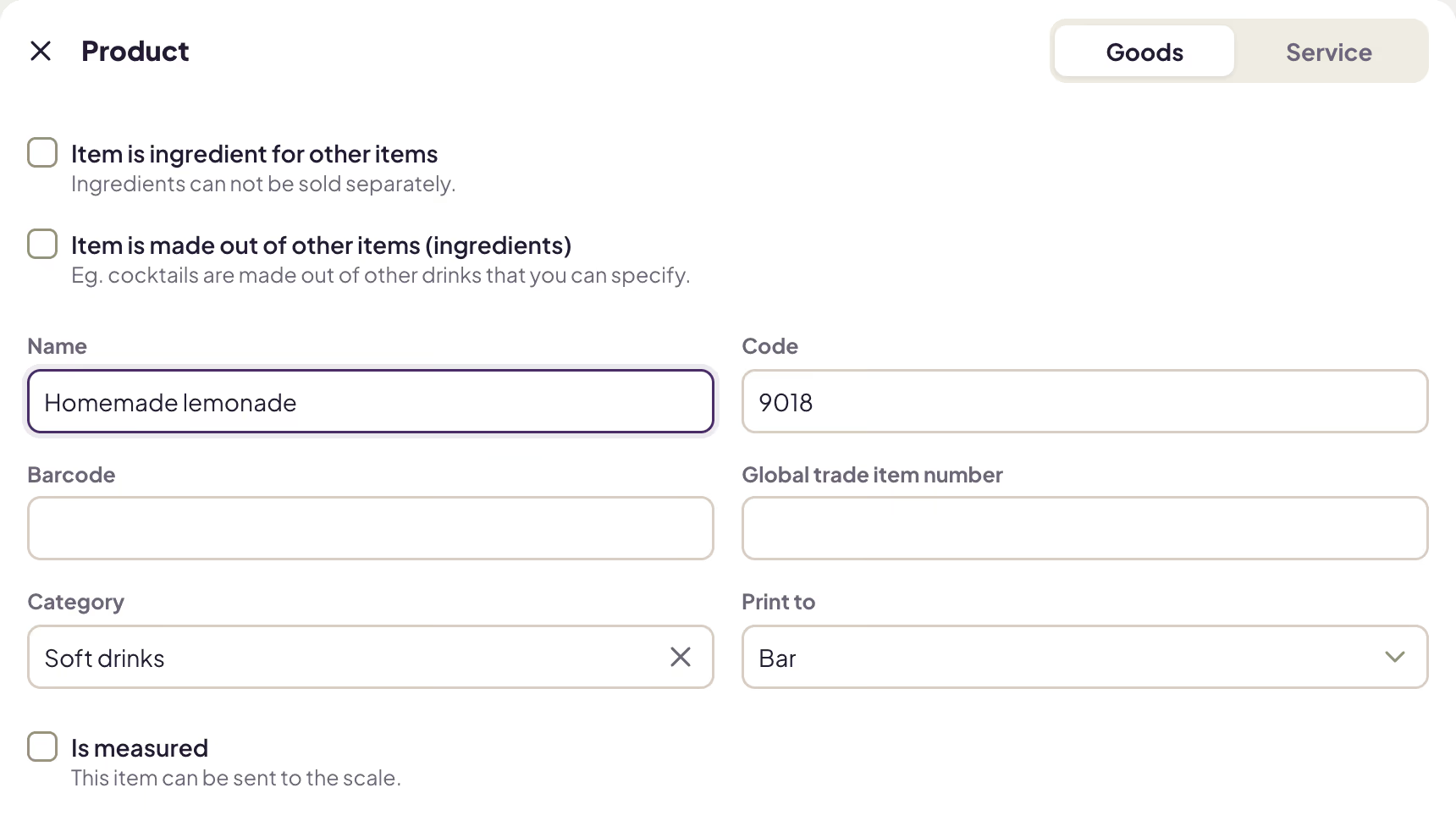
The item window — the fields depend on the item type, the business type and the venue's modules
Goods or service
Goods are everything that has stock: drinks, food, products in a shop. A Service has no stock (for example delivery, a booking fee, rental). For a service, Barcode, Global trade item number, Is measured, In stock, Minimum stock, Require quantity and the choice of ingredients are not shown. When you switch an item to Service, the barcode, GTIN, ingredient options and price are cleared — enter the price again.
Item fields
| Field | What you enter | When it is shown |
|---|---|---|
| Item is ingredient for other items | The item is not sold on its own, has no selling price and is used as an ingredient (see Items made of ingredients). | Goods; hospitality, Inventory item ingredients module |
| Item is made out of other items (ingredients) | The item is made of ingredients, for example a cocktail. | Goods; hospitality, Inventory item ingredients module |
| Name | The item's name, up to 200 characters. Required. | Always |
| Code | A new item gets the next free number, which you can change. Required for an item that is measured. | Always |
| Barcode | The barcode from the package. | Goods |
| Global trade item number | The GTIN, from 8 to 14 characters. | Goods |
| Category | Choose an existing category or type the name of a new one (at least 3 letters) and click the suggestion to create it ("Category "…" does not exist. Create it?"). In hospitality you also choose the type for a new category. The new category is created when you save the item. | Always; required in hospitality |
| Print to | The printer the item is printed on in the order slip: Bar, Kitchen, Sector I or Sector II (see Printers → Printer roles). A category of the Food type sets Kitchen by itself, and the Drinks type Bar. | Hospitality; required |
| Is measured | The item is sent to the scale (see Sending items to the scale). The app creates the barcode of such an item from its code, by the pattern on the Weight Barcodes page — a barcode you enter is replaced. | Goods; Scales integration |
| Price after tax | The selling price, at least 0.01. Required for an item that is sold. | Always; locked for an ingredient |
| "Pricelist name" Price | The item's price on that pricelist, for example Happy hour Price. While the field is empty, the base price applies on that pricelist; a saved price is not removed by clearing the field (see Item prices on a pricelist). | Pricelists module, hospitality, without inventory accounting |
| Purchase price, Price difference | Filled in by the price calculation. You enter the purchase price of an ingredient by hand. | Inventory accounting |
| Tax rate | The item's tax rate. If the venue has only one rate, it is already chosen. Required. | Always |
| In stock | The current stock. With inventory accounting, only inventory documents change the stock. | Goods not made of ingredients; not shown when Do not keep stock of the items is on |
| Minimum stock | The lowest stock of the item. If a low-stock notification is set up for the venue, a list of the items below this stock arrives by email. | The same as In stock |
| Unit | The unit of measure: pcs, kg, g, l, m, m2, m3, h, day or t. You can also type your own unit and click "Unit does not exist. Create it?". Required. | Always |
| Selling unit | The unit the item is sold in; it is printed on the receipt. | Retail, when the Unit is not pcs |
| NET quantity in g / in ml | The net quantity of the package. Used for the price per kilogram or liter on the price tag. | Retail, when the Unit is kg or l |
| Require quantity | When the item is chosen, the register opens a window for entering the quantity — in retail only when it is chosen on the Buttons and List tabs (see Retail Sales). | Goods that are sold |
| Description, Image URL | The description and the address of the item's image for the digital menu. | An item that is sold; QR ordering or the delivery module |
| Allergens and dietary labels | Allergens and labels (for example Vegan, Gluten-free) for the QR menu. | QR ordering |
| Alcohol (%) | The alcohol content, for delivery platforms. | Delivery module |
| Do not send to delivery platforms | The item never appears in the menus sent to delivery platforms. | Delivery module |
The Do not keep stock of the items option is turned on in the venue settings (see My Account → Venue settings). The low-stock notification and the recipients of that email are set up by Konty support.
Note
If the venue keeps inventory accounting, the price of goods is locked in the item window — it is changed by a price calculation or a price leveling (see Inventory Accounting). New goods then start with a price and stock of 0. If Konty support has allowed price changes of existing goods for the venue, changing the price of existing goods in the item window automatically creates a price leveling. The price of a service is always changed in the item window.
Copying an item
Copying is a quick way to create a similar item, for example the same drink in another size.
- In the item's row, open ⋮ and choose Copy.
- Enter the Name of the new item and change the other fields if needed.
- Click SAVE.
The copy takes over the details of the chosen item, except the name — including its stock (In stock), so check it before saving. The Code gets the next free number, and the Barcode and Global trade item number stay empty.
Items made of ingredients
An item made of ingredients (for example a cocktail or a sandwich) has no stock of its own — when you sell it, the stock of its ingredients is reduced. Ingredients are items marked Item is ingredient for other items; they are not sold on their own.
Availability
Ingredients exist in hospitality, when the Inventory item ingredients module is on, and only for goods.
First add the ingredients:
- Click ADD and choose Goods.
- Tick Item is ingredient for other items.
- Enter the name, the unit (for example l or kg) and the stock, then click SAVE.
Then create the item made of ingredients:
- Click ADD, choose Goods and tick Item is made out of other items (ingredients).
- Fill in the name, category, price and tax rate.
- Click GO TO INGREDIENTS.
- In the Search field, find the ingredient and click it. The ingredient is added to the list.
- Enter the quantity of the ingredient in its unit (for example 0.05 if the unit is l).
- Repeat steps 4 and 5 for the other ingredients. You remove an ingredient with the red ✕.
- Click SAVE.
You see an item's ingredients in the list, through ⋮ → Details. An ingredient used in an item cannot be turned into an item that is sold, nor deleted — the app reports that the item is used as an ingredient of other items.
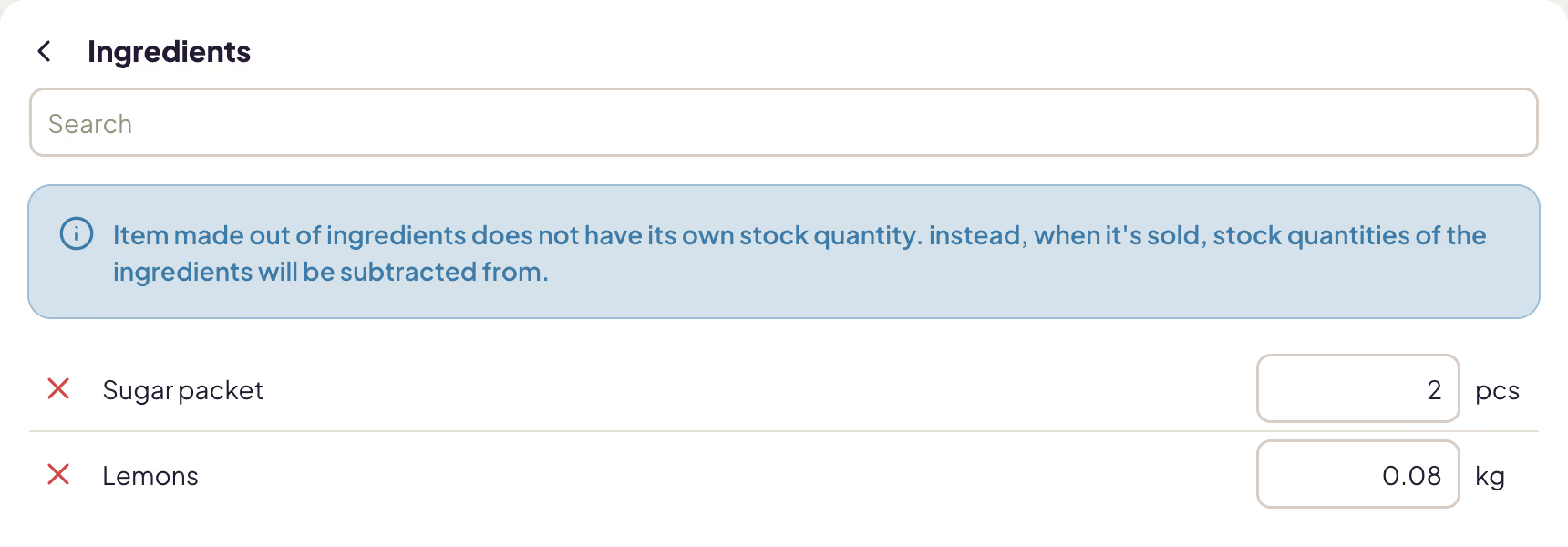
An item's ingredients — the quantity is entered in the ingredient's unit
Deleting an item
- In the item's row, open ⋮ and choose Delete.
- In the "Permanently delete the Inventory Item?" window, click CONFIRM.
A deleted item is no longer offered at the register and cannot be restored. An item that was never sold is deleted completely, so you can give its code, barcode and GTIN to a new item. An item that was sold is kept because of the issued receipts, so its code, barcode and GTIN stay taken.
An item cannot be deleted in these cases:
| Reason | Message |
|---|---|
| The item is an ingredient of another item. | The app reports that the item is used as an ingredient of other items. |
| The item is made of ingredients. | "Product made out of ingredients could not be deleted." |
| The item is on a delivery-out note. | "Product could not be deleted because it is documented in a dispatch." |
| The item is on a delivery-in note. | "Product could not be deleted because it is documented in a reception." |
| A price calculation exists for the item. | "Item could not be deleted because there are price calculations that refer to it." |
Quick price changes
The Prices tab, next to the List tab, is for changing the prices of several items at once, without opening the item window. All changes are saved with one click.
- Click the Prices tab.
- In the Search field, type the name, code or barcode (or scan the barcode) and press Enter — the cursor moves to the New price of the first item found. You can also choose an item by clicking its row.
- Type the new price and press Enter — you move to the next item. After the last item, the cursor returns to Search.
- When you are done, click SAVE PRICES (the button shows the number of changed prices).
The prices are saved with the message "Prices saved: …".
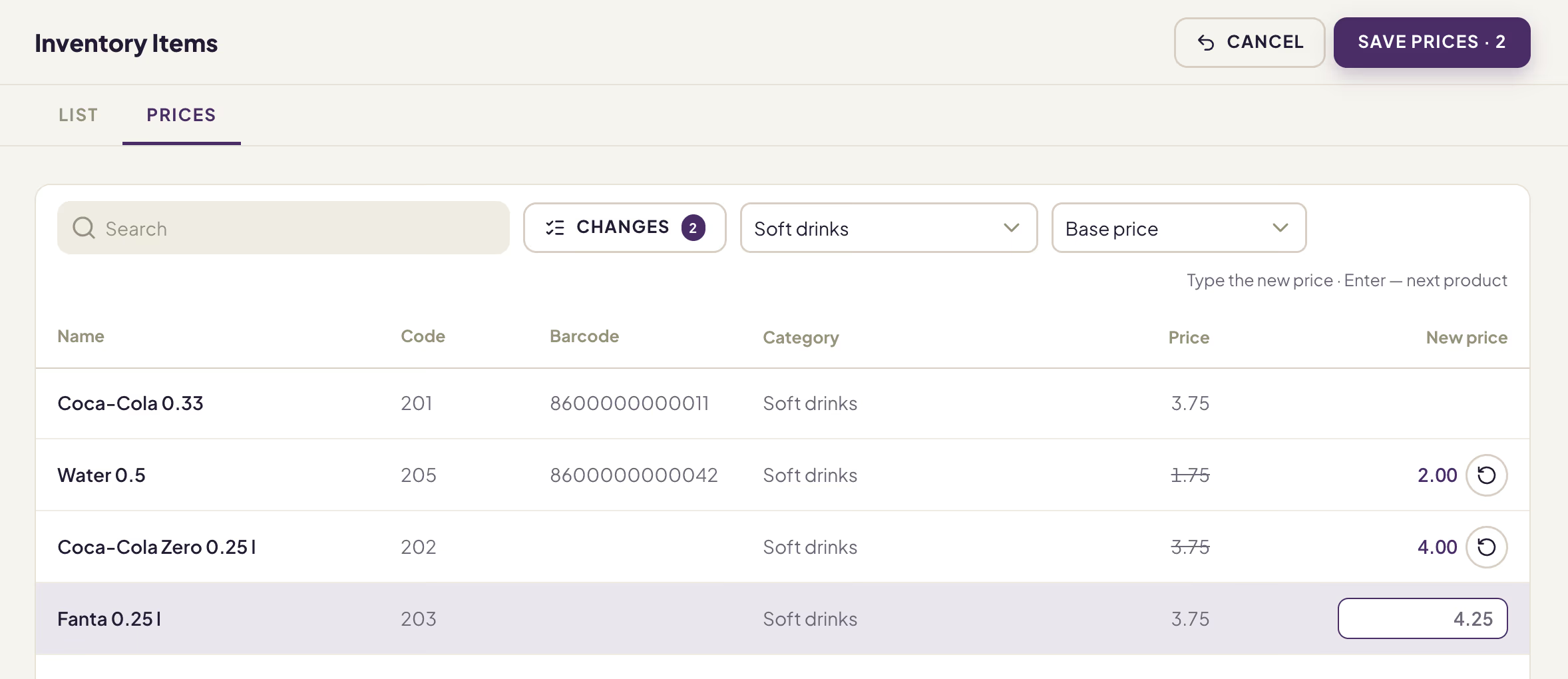
Quick price changes — the new price is entered in the New price column
- A changed price is shown next to the struck-through old price. The CHANGES button shows only the items with a changed price, and the ↺ (Undo) icon in the row returns that item's old price.
- Esc clears the typed price; if nothing is typed, it returns the cursor to Search.
- CANCEL in the header discards all unsaved changes (confirm with DISCARD).
- Above the table you choose the category, and if the venue uses pricelists, also the pricelist whose prices you change (Base price or the pricelist's name).
- If the new price is at least twice the old one or at most half of it, the "Check unusual prices" window opens after SAVE PRICES with a list of those items. Click SAVE ALL, or FIX to go back to the first such price.
- If you leave the page before saving, the app asks for confirmation first.
Ingredients are not shown on the Prices tab. An item with a padlock icon has a locked price ("This product's price changes through a price calculation or leveling.") — these are goods in a venue that keeps inventory accounting.
The same quick price change also exists at the register (see Options → Quick price changes).
Import and export of items
You do not have to enter goods and services one by one: you can import the item list from an Excel spreadsheet and export it to an Excel file. All import and export options are in the ⋮ menu in the header of the Inventory Items page.
Importing items from Excel
Importing adds several new items at once, from an Excel (.xlsx) or .csv file.
- In the ⋮ menu, choose Import your menu items.
- Click Menu items file to import and choose the file.
- Click IMPORT.
The items are added with the message "Items imported successfully." and are shown in the list.
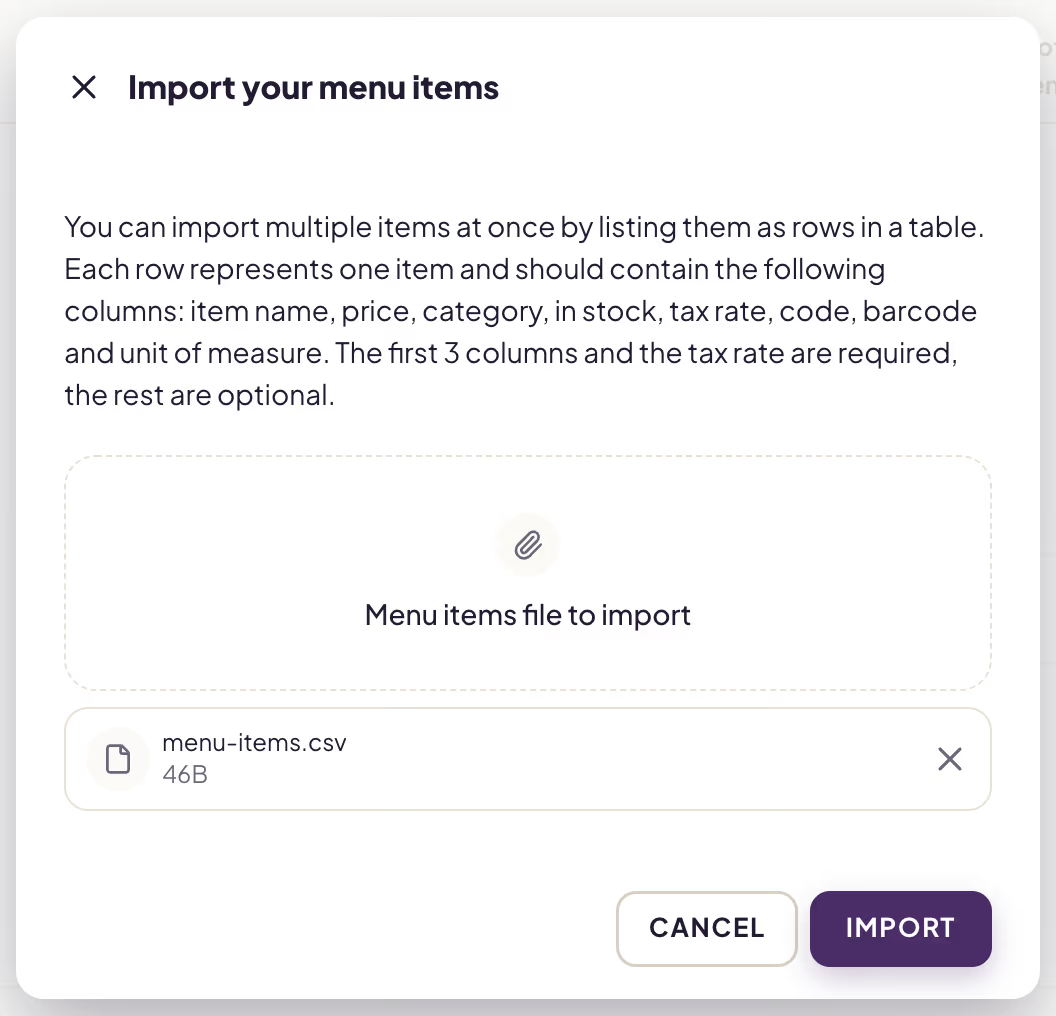
Importing items — the window lists the columns of the spreadsheet and their order
What the file looks like. Each row of the spreadsheet is one item — starting with the first row. The spreadsheet has no row with column names; if you add one, the import fails, because the first row is read as an item. Only the first sheet of the file is imported. The columns, in order:
| # | Column | Required | Note |
|---|---|---|---|
| 1 | Item name | yes | Up to 200 characters. |
| 2 | Price | yes | The selling price including tax, as a number. |
| 3 | Category | yes in hospitality, no in retail | A category that does not exist is created. |
| 4 | In stock | no | The stock, as a number. Empty is 0. |
| 5 | Tax rate | yes | The rate in percent, as a number — one of your venue's tax rates. |
| 6 | Code | no | Must not repeat in the file or exist on another item. |
| 7 | Barcode | no | The same rule as for the code. |
| 8 | Unit of measure | no | The unit's code (see below). Empty is pcs. |
| 9 | Global trade item number | no | The GTIN, from 8 to 14 characters, unique. The import window does not list this column. |
An example of the first three rows (the letters are the Excel column names, not part of the file; the example assumes your venue has an 8% and a 0% tax rate):
| A | B | C | D | E | F | G | H | I |
|---|---|---|---|---|---|---|---|---|
| Espresso | 3.50 | Hot drinks | 8 | 501 | pcs | |||
| Croissant | 2.20 | Bakery | 60 | 0 | 101 | 2000001000014 | pcs | |
| Gouda cheese | 14.90 | Dairy | 12.5 | 0 | 102 | kg |
The Unit of measure is entered as a code: pcs, kg, g, l, m, m2, m3, h, day or t. An empty cell means pcs.
The Tax rate is entered as a number of percent and matched with your venue's tax rate of the same rate: 8 with a rate of 8%, 0 with a rate of 0%. A new account has no tax rates yet — add yours first in Settings → Tax Rates (see Tax Rates) and use only those rates in the file.
Warning
A rate your venue does not have is not reported row by row: the import stops with the message "Import failed. Please fix the following errors and try again.", without a list of errors. Some items and new categories may already be imported by then — check the item list before importing again.
Errors in the file. If any row has an error, the app imports no items, and for each such row the window lists the error, for example "Row #3: Item price is required." The row number is the row number in Excel. Correct the file, choose it again and click IMPORT.
New categories in hospitality. If all rows are correct but the file contains categories that do not exist yet, the window asks you to give each one a type ("To complete the import please assign a type to each of these categories."). Choose Drinks, Food or Other for each category and click IMPORT again. The type decides where the imported items are printed: Drinks — Bar, Food — Kitchen, Other — Sector I. In retail, a new category is created without a type.
Other import rules:
- Every imported item is goods that are sold. Open an item that is a service after the import and switch it to Service.
- If the venue keeps inventory accounting, imported goods get a price and stock of 0 — you enter the price and stock with inventory documents (see Inventory Accounting).
- Importing does not change existing items. To change existing items, use Edit existing ones.
Changing existing items from a spreadsheet
The Edit existing ones option changes the details of items that already exist, and adds the items that do not exist as new ones. The file has the same columns, in the same order, and also has no row with column names.
- In the ⋮ menu, choose Edit existing ones.
- Click Menu items file to import and choose the file.
- Click IMPORT.
- An item is recognized by its code, then by its barcode, and if neither is entered — by its GTIN. A row whose code and barcode belong to two different items is skipped.
- For an item that is found, all the details from the row are written: an empty cell deletes the existing detail (for example the barcode or the category), and an empty unit of measure becomes pcs.
- The stock from the file is added to the current stock — it does not replace it.
- The required columns are the same as for importing new items. If a row has an error, nothing is imported, and the errors are listed by row. Skipped rows (code and barcode of two different items) are not reported — check the list after the import.
Tip
The easiest way is to export the items (Export as .xlsx), change prices or names in Excel and import the file with Edit existing ones. Before importing, clear the values in the stock column (D) — otherwise the existing stock is added once more.
Availability
Edit existing ones is not available when the venue keeps inventory accounting.
Warning
Do not use Edit existing ones for ingredients or items made of ingredients — every item from the file becomes an item that is sold and is not made of ingredients.
Exporting items
Exporting downloads the item list to an Excel file, for example to review prices, for your accountant or to edit in Excel.
- In the ⋮ menu, choose Export as .xlsx.
- The file
inventory_items.xlsxis downloaded to your device.
The file contains all items that are sold — goods and services — except ingredients and items made of ingredients (you export those with Export ingredients). The columns are in the same order as for the import (name, price, category, stock, tax rate, code, barcode, unit of measure, GTIN), followed by the purchase price, the NET quantity and the price difference. The file has no row with column names, so you can change it and import it again.
Importing and exporting ingredients
Items made of ingredients, together with their ingredients, are imported and exported with a separate file.
Availability
The options exist in hospitality, when the Inventory item ingredients module is on.
- Export ingredients downloads the file
ingredients.xlsx. The first row holds the column names (in Serbian). For each item made of ingredients there is one row (category type, category, code, name, unit, rate, price, stock, purchase price), below it a heading row for its ingredients and one row for each ingredient (code, name, unit, quantity, stock). An ingredient not used in any item has only its own row. The rows are sorted by category name. - Import ingredients imports a file with the same layout: choose Ingredients file to import and click IMPORT. The first row of the file holds the column names and the import always skips it — do not delete it. An item row is recognized by a filled-in column A (the category type:
drinks,foodorother), and the category in column B must already exist under the same name — otherwise the item is imported without a category.
Every item and every ingredient in the file must have a code. An ingredient whose code already exists is used as it is, and an item made of ingredients whose code already exists stops the import. If the import fails, nothing is imported ("Importing ingredients failed."). Use a file created with Export ingredients as a template.
Sending items to the scale
The Export for scale option writes the items marked Is measured to a file that your scale's program reads, and starts sending them to the scale.
Availability
The option exists when the Scales integration is on. It works only when you open Administration from the installed app on a Windows computer connected to the scale — not from a browser.
- In the ⋮ menu, choose Export for scale. The Synchronize with scale window opens.
- Check the Path to items file and the Script path. On Windows they are filled in already (for example
C:\BIZERBA\plst.txt); you change saved paths after clicking the pencil icon. - Click RUN.
Note
The window currently always suggests the paths for a Bizerba scale. If you use a Rongta scale, contact Konty support before the first export.
The message "Scale synchronisation finished" means that the items were written to the file and sent to the scale. The paths are remembered on that computer.
Printing price tags
On the Print price tags page you create and print price tags for shelves and display cases. Each tag shows the item's name and price, the barcode (if the item has one) and the code, and an item with a NET quantity also shows the price per kilogram or liter.
- On the Inventory Items page, in the ⋮ menu, choose Print price tags.
- In the Show section, choose which items you print:
- All — all items that are sold;
- Selected — only the items you choose: find an item in the search field and click it; each click adds one tag, so an item chosen twice gets two tags;
- Updated in 24h — items whose price or other detail was changed in the last 24 hours.
- With the Price tag height slider, set the height of the tag, and with the Price tags per row slider, how many tags fit in one row (from 2 to 8).
- Click PRINT and choose the printer in the print window.
The view splits the tags into groups of at most 200 (the group choice is below the tags). PRINT prints only the group that is shown — for the others, choose the next group and click PRINT again. The height and the number per row are remembered on that device. The arrow to the left of the title takes you back to the item list.
Item categories
Categories group items at the register and in reports. You open the page in the Inventory menu → Item Categories. The list shows the name and, in hospitality, the type of the category; you search it by name, and a click on a row opens the category for editing.
In hospitality, every category has a Type: Drinks, Food or Other. The type decides:
- on which tab of the order screen (Drinks, Food, Other) the category's button is created (see Hospitality Sales and Settings → Sales Interface Settings); changing the type later does not move an existing button;
- the item's default printing location: when you choose a category of the Food type for an item, Print to becomes Kitchen, and for the Drinks type Bar.
In retail, categories have no type.
Adding and editing a category
- Click ADD (to edit, click the category's row).
- Enter the Name. Two categories cannot have the same name.
- In hospitality, choose the Type.
- Click SAVE.
You can also create a category from the item window or by importing items (see Item fields and Importing items from Excel).
Deleting a category
In the category's row, open ⋮, choose Delete and click CONFIRM. A category that has items cannot be deleted ("Category could not be deleted because there are products that have this category assigned to them.") — first give those items another category.
Item modifiers
Modifiers are prepared extra requests from guests, for example "no sugar" or "medium rare". The waiter chooses them at the register with an order item, instead of typing them (see Issuing Receipts → Comment). A modifier is printed on the order slip for the bar or kitchen, and on the receipt only if Show item comments on receipts is turned on in the venue settings (see My Account → Venue settings).
To add a modifier:
- Open Inventory → Item Modifiers.
- Type the text in the Enter modifier field.
- Click ADD or press Enter.
The modifier is added to the list. The same modifier cannot be added twice ("Entered modifier is already on the list."). You delete a modifier with the red ✕ at the end of its row and confirm with CONFIRM. Modifiers cannot be changed — delete a wrong one and add a new one.
Note
The list of modifiers is used on the order screen in hospitality. In retail, the cashier types a comment for an item as free text.
Pricelists
A pricelist gives the same items different prices — for example for happy hour, the terrace or an event. Every pricelist has its own price in the item window, and at the register it is chosen for a receipt or applied by itself, through the buyer.
Availability
The Pricelists page exists in hospitality, when the Pricelists module is on and the venue does not keep inventory accounting.
Adding a pricelist
- Open Inventory → Pricelists.
- Click ADD.
- Enter the Name and leave Active on.
- Click SAVE.
Only active pricelists are shown at the register and in the item window — turn Active off to hide a pricelist temporarily. You change a pricelist by clicking its row, and delete it through ⋮ → Delete and CONFIRM.
Item prices on a pricelist
In the item window, in the Price and Stock section, there is a field with the name of each active pricelist, for example Happy hour Price. Enter the price on that pricelist and click SAVE. While the field is empty, the base price (Price after tax) applies on that pricelist. A saved pricelist price is not deleted by clearing the field — if you want the base price to apply on the pricelist again, enter the same amount as in Price after tax.
You change pricelist prices for several items at once on the Prices tab, after choosing the pricelist above the table (see Quick price changes).
A client's pricelist
You can assign a pricelist to a client in the Pricelist field of their window (see Clients → Client fields). When you choose that buyer on a receipt at the register, the receipt switches to their pricelist, unless another pricelist is already chosen for the table. How a pricelist is chosen at the register is described in Hospitality Sales → Pricelist.